
Logo vs. Brand Identity: Why Your Skincare Logo Alone Won’t Sell

A founder emails: “I got my logo done for $400 on Fiverr — I think the branding is handled.” It isn’t. The logo is one asset. The brand identity is the full system that makes a logo mean anything in the first place. Launching a skincare brand with just a logo is like launching a product with just a label — the thing exists, but it has nowhere to live.
Here’s what the difference actually is, and why it decides whether your brand reads premium or reads cheap on day one.
What a Logo Is
A logo is a mark. Usually a wordmark (the name set in a specific typeface), a symbol, or a combination of both. Its job is identification — making you recognizable across any surface where the mark appears. That’s it.
A good logo is simple, legible at any size, works in one color, and holds up at a glance from across a room. A great logo also carries a hint of the brand’s personality — but only a hint. A logo cannot carry a full brand on its own, and asking it to is why most DIY skincare brands look thin.
What a Brand Identity Is
Brand identity is the system a logo lives inside. At minimum it includes: the logo (and its variants — primary, secondary, mark, favicon), a color palette (primary, secondary, functional), a typography system (headlines, body, small print), imagery direction (photography style, art direction, texture language), and usage rules (how it all works together on a bottle, a web page, a sales deck, an Instagram story).
On skincare specifically, a brand identity also usually includes packaging architecture — how a 3-SKU line scales to 8 SKUs without breaking the system, how primary and secondary packaging relate, how a new product category (say, body) extends the identity without starting over.
Where “Just a Logo” Fails
Three places, in order of damage.
On the shelf. A Sephora buyer looking at a shelf doesn’t see a logo. They see a bottle. The bottle has a label, a shape, a color, a weight, a typeface, a hierarchy of information. If you only invested in the logo, every one of those decisions got made in a vacuum — usually by a printer, a packaging supplier, or the founder on Canva at midnight. The result reads as an amateur project next to brands with a full identity system. (We wrote more about why that gap is visible.)
On the website. A logo in a header does nothing to tell a visitor who you are, who you’re for, or why to trust you. The identity does that work — the color choices that signal “clinical” vs. “indulgent,” the typography that says “accessible” vs. “elevated,” the photography style that places you in the market.
On the second product. Launch one SKU with a logo and you can usually get away with the gap. Launch a fourth, and the lack of a system becomes visible. Nothing coordinates. The brand looks like four separate products that happen to share a name.

Why Founders Under-Buy
The usual reason is sticker shock. A $400 logo is comprehensible; a $25,000 brand identity isn’t, until you’ve seen the alternative on a retail shelf. The second reason is confusion about what “branding” means — the word gets used for everything from a logo to a positioning document, which lets a $400 vendor and a $40,000 agency both claim they’ll “handle your branding.” (We broke down what sits inside those numbers in how much skincare branding costs.)
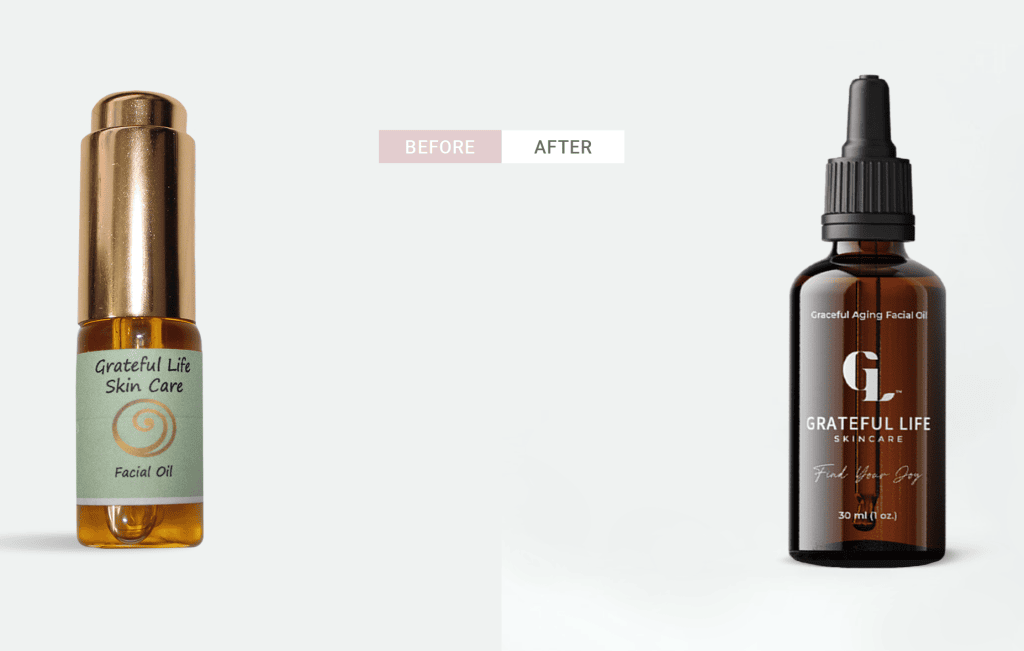
The third reason: founders assume they can “add the rest later.” You can — but adding the rest later means paying for the brand twice. Once for the thin version, again for the full system when the thin version stops working. The Grateful Life Skincare rebrand on our case studies page is a cleaner example of what happens when the full system comes together from the start.
What Else a Full Identity Buys You
A couple of things that only become visible once you have them. Defensibility — a complete identity is harder for a competitor to look-and-feel copy, and easier to legally protect as trade dress once the system is established. Scaling speed — new SKUs, new campaigns, new retailers all slot into an existing system instead of requiring one-off design decisions. Hiring leverage — your next hire, your packaging supplier, your social manager all work faster from a brand book than from “whatever looks on-brand to you.” The research backs the business case: Interbrand’s valuation methodology treats brand identity as a measurable asset in company valuations, because it is one.
What to Do If You Already Launched With Just a Logo
Don’t panic-rebrand. Audit. If the logo is strong and legally clear, you may be able to build an identity system around it rather than replacing the mark. If the logo is also the problem, a full rebrand is the right call — the signs it’s time are the same ones we covered in when to rebrand your skincare brand and the colors post, common skincare brand color mistakes.
If you’re sizing up what a full identity would cost and include, our services page breaks it down.