How Much Does Skincare Branding Cost? (What Agencies Charge and Why)

Most agencies make you book a call to hear a number. Here are the numbers first: a freelancer will brand your skincare line for $2,000 to $8,000, a boutique agency for $15,000 to $50,000, and a large agency for $75,000 to $250,000 or more. All three can be the right answer. All three can also be money down the drain, depending on what your brand actually needs and what you get for it.
This post breaks down what sits inside those ranges, what pushes a project toward the top or bottom of one, the hidden costs most founders don’t see until invoice two, and the specific ways a cheap branding project becomes the most expensive line item in your launch.
What You’re Actually Paying For
“Branding” quotes vary wildly because the word hides very different scopes. A full skincare branding project typically includes brand strategy and positioning, naming support, visual identity (logo system, color, typography), packaging design for your launch SKUs, and the file handoff that lets you print and build without going back to the designer for every asset. Some projects add photography direction, a website, and retail sell-in materials.
When one quote says $4,000 and another says $40,000, the first is usually a logo and a label template. The second is usually the whole system. Neither quote is dishonest — they’re pricing different products. Before comparing numbers, compare scopes line by line. (We broke down the full scope in what’s included in a skincare branding project.)
The Three Price Tiers
Freelancer: $2,000–$8,000. You’re paying for one person’s design skill. At this tier you can get genuinely beautiful work, but strategy, retail experience, and compliance awareness usually aren’t part of the deal — and the coordination burden lands on you. This tier fits a founder testing an idea at farmers markets or DTC-only, with a plan to rebrand before retail. We covered the tradeoffs in freelancer vs. skincare branding agency.
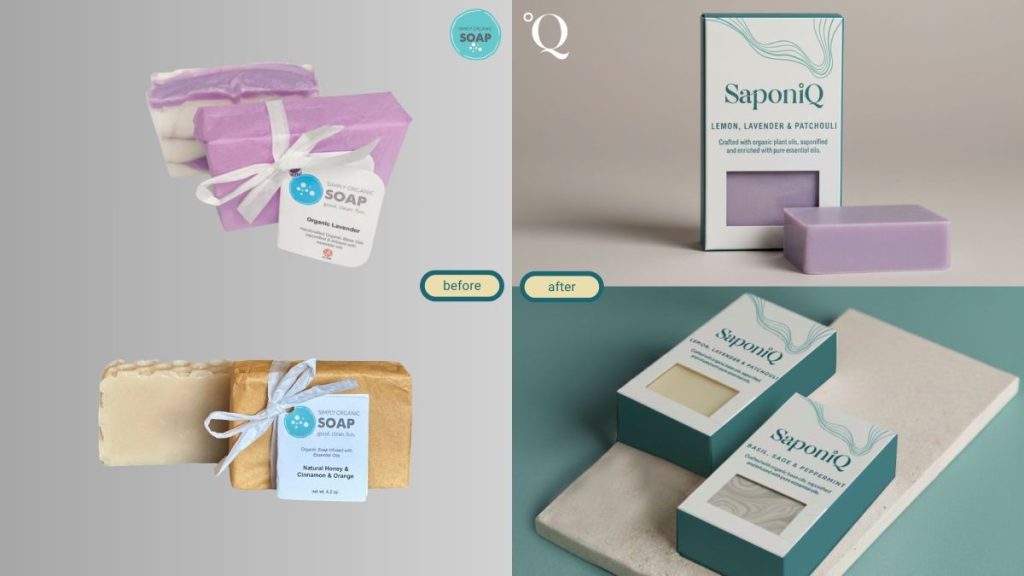
Boutique agency: $15,000–$50,000. A small team with a defined process: strategy, identity, packaging, and handoff. Specialist boutiques price in the same range as generalists but carry category knowledge — how a box needs to behave on a Sephora shelf, what a Credo buyer expects, where the FDA-required copy has to sit before the design is built around it. This is the tier most funded or retail-bound skincare brands should be comparing.
Large agency: $75,000–$250,000+. Multiple teams, research phases, brand architecture. The right call for a multi-line company or a brand with significant investor money and a national retail commitment on a deadline. Overkill for a three-SKU launch.
What Moves the Price Inside a Tier
Five variables explain most of the spread. SKU count: each additional product is another packaging design, another dieline, another proof cycle; a 3-SKU launch and a 12-SKU line are different projects. Retail versus DTC: retail packaging has to survive a shelf fight and a buyer review, which adds structural design and sell-in materials. Strategy depth: a brand that knows its positioning needs less discovery than one that arrives with “clean skincare for everyone.” Naming: if the agency has to name the brand (and clear it against existing trademarks), add $3,000 to $15,000. Timeline: compressing a 4-month project into 8 weeks costs rush premiums at every step.
The Hidden Costs Most Founders Don’t See Coming
A $25,000 branding quote is almost never a $25,000 branding bill. Here are the line items that get added, in rough order of how often they catch founders off-guard:
Photography. Lifestyle and product photography is usually a separate line, running $3,000 to $15,000 depending on scope. If the agency says “we’ll art direct your shoot,” that’s a different number than “we’ll run the shoot” or “we’ll produce the images.”
Additional SKUs added mid-project. You started with 3 SKUs. You decide to add 2 more halfway through. That’s not a free addition — it’s another $2,000 to $5,000 per SKU in packaging design, dielines, and proof cycles.
Extra revision rounds. Most agencies include 2–3 rounds per phase. Founders who need a fourth round at the identity phase, then another at packaging, can easily add $3,000 to $10,000.
Source files. Not every agency includes editable source files in the base quote. Some charge $500 to $2,500 for file handoff. Ask upfront; the answer should be included, but if it isn’t, know the number before you sign.
Sell-in decks and retail materials. Line sheets, pitch decks, buyer-facing one-pagers — all commonly add-ons at $1,500 to $5,000.
Website design and build. A branding project rarely includes a Shopify site build. Expect $8,000 to $25,000 extra, often from a separate specialist.
Print production management. Who manages the back-and-forth with your printer? If the answer is “you,” plan for weeks of your own time. If the agency handles it, that’s often $1,500 to $5,000 extra.
Rush fees. Compressing timeline costs 20–40% on top of base.
Add it all up and a $25,000 “branding project” quietly becomes a $45,000 all-in launch spend. Not because anyone was dishonest — because “branding” and “launch” aren’t the same budget.
Red Flags in a Low Quote
The $3,000 project that becomes a $15,000 problem usually has three warning signs on day one. No written scope. If the quote is one line (“full branding package — $3,000”), the deliverables will shift during the project and so will the price. No strategy phase. The project jumps straight into logo concepts in week one. You will pay for the missing strategy later, either in revisions or in a brand that doesn’t say anything. Unlimited revisions. Sounds generous, is actually a tell. Agencies with unlimited revisions don’t have a strong process; the project ends when you give up, not when the brand is right.
Agency vs. Freelancer: Total Cost of Ownership
The sticker-price comparison misleads. A freelancer at $5,000 looks like a 5x bargain against a boutique at $25,000 — until you count the hours. Freelance projects usually mean the founder is the project manager, the strategist, the brief writer, and the coordinator between designer, printer, and photographer. That’s often 60–100 founder-hours over 2–3 months. At any realistic valuation of a founder’s time ($100–$200/hour), the “cheap” project costs an additional $6,000–$20,000 in opportunity cost.
Boutique agencies absorb most of those hours. You still show up to key meetings and make the decisions, but you’re not running the project. For a founder about to launch a product, that reclaimed time is often the difference between a smooth launch and a chaotic one.
What a Real $30,000 Project Looks Like
A representative scope for a boutique skincare branding project around $30,000: 2 weeks of strategy and positioning (including a competitor audit and customer definition), 3 weeks of visual identity development (logo system, color, type, 3 refined concepts narrowed to one), 4 weeks of packaging design for 4 launch SKUs (primary and secondary), 1 week of brand guidelines documentation, final file handoff with editable source files, and 2 standing calls per week throughout. Deliverables run to roughly 40–60 production files plus a 25-page guidelines PDF. At $30,000, you’re paying roughly $300/hour of senior creative time — which, in the agency market, is normal.
Where Cheap Gets Expensive
The $3,000 branding project doesn’t stay a $3,000 project when the brand has retail ambitions. The pattern we see, in order: the brand launches, gets traction, pitches a retailer, and the buyer passes — packaging doesn’t hold up next to established competitors. Now the founder pays for a rebrand (the full price they avoided the first time), plus reprinting packaging inventory, plus new photography, plus the sales momentum lost during the transition. Founders who look cheap on the shelf rarely get told that’s the reason; they just don’t get the follow-up meeting.
McKinsey’s State of Beauty research keeps landing on the same point: beauty is a brand-driven category where customers buy the brand before the formula. Underfunding the brand to protect the formulation budget optimizes the wrong asset.
How to Budget for It
A working rule: brand and packaging design should be roughly 10–20% of your total launch budget. If you have $50,000 to launch, a $6,000–$10,000 branding spend at the freelancer tier is proportionate. If you’ve raised $500,000 and you’re pitching Ulta in 12 months, a $30,000–$50,000 boutique project is the proportionate move — and a $3,000 logo is a false economy.
A second working rule: budget the branding project at 1.3x the quoted number to account for the add-ons above. If the agency quotes $25,000, plan on $32,000–$33,000 all-in. If the final bill comes in at exactly $25,000, that’s a happy surprise, not the expectation.
If you’re pricing out a skincare branding project right now, our services page explains how we scope and what’s included at each level.